
Accounting is often called the language of business because it records, classifies and summarises business transactions in a systematic way. For Class 11 students, understanding the role of accounting and basic accounting terms is the first step towards mastering the subject.
In this article, you will learn:
- Meaning and role of accounting in modern business
- Different roles of accounting (language, historical record, information system, etc.)
- Objectives and qualitative characteristics of accounting information
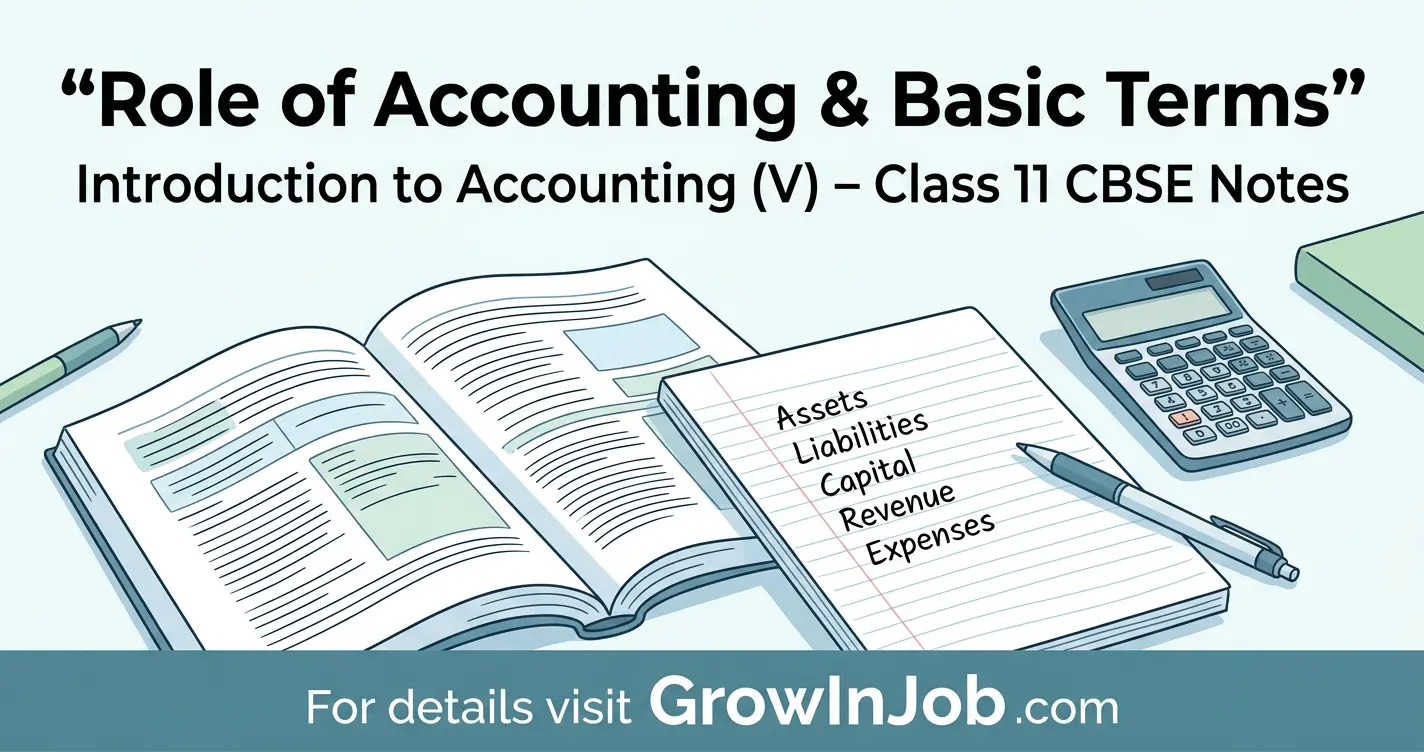
- Important basic terms in accounting as per Class XI syllabus (assets, liabilities, capital, revenue, expenses and more)
Use these notes for exam preparation, quick revision and as a complete guide to “Role of Accounting and Basic Terms in Accounting” for Class 11.
What Is Accounting? (Quick Revision)
Accounting is the process of identifying, measuring, recording and communicating economic events of an organisation to interested users of information.
In simple words, accounting:
- Identifies financial transactions
- Measures them in monetary terms
- Records them in a systematic manner
- Summarises them into financial statements
- Communicates information to users like owners, investors, lenders, government and others
Objectives of Accounting (Class 11)
For Class 11, the primary objectives of accounting can be summarised as:
- Maintaining systematic records of business transactions
- Calculating profit or loss for a given accounting period
- Depicting the financial position through a balance sheet
- Providing useful financial information to various internal and external users
These objectives guide the entire accounting process and help in decision making.
Role of Accounting in Modern Business
Over the centuries, the role of accounting has changed with economic development and increasing needs of society. Today, accounting plays multiple roles in every type of organisation.
Accounting describes and analyses a huge mass of financial data through measurement, classification and summarisation, and then presents this data in the form of reports and financial statements showing the financial condition and performance of the business. Because of this, accounting is regarded as both a language of business and an information system.
Different Roles of Accounting (Class 11 Focus)
Accounting plays the following roles:
As a language of business
It is used to communicate financial information about an enterprise to various users.
As a historical record
It provides a chronological record of all financial transactions at actual amounts, useful for reference and analysis.
As current economic reality
It helps in determining the true income of an entity, that is, the change in wealth over time.
As an information system
It links the information source (the accountant) with users (such as owners, lenders and government) through financial reports and statements.
As a service or commodity
Accounting information is a specialised service demanded by society, and accountants provide this information to different users.
Users of Accounting Information
Important users of accounting information include:
| Owners and investors | to know profitability and financial position |
| Management | for planning, control and decision making |
| Lenders | to evaluate the ability to repay loans |
| Government and regulators | to see taxes, compliance and allocation of resources |
| Employees | to judge stability and growth of the business |
| Social responsibility groups | to assess environmental and social impact |
| Creditors and suppliers | to analyse the firm’s ability to pay dues |
| Competitors | for comparison and strategy building |
Accounting information generally relates to past transactions and is quantitative and financial in nature, so it does not provide qualitative and non‑financial details. These limitations must be kept in mind while using accounting information.
Qualitative Characteristics of Accounting Information
For accounting information to be useful in decision making, it should possess some key qualitative characteristics:
|
Reliability |
information should be verifiable, faithful and free from bias. |
|
Relevance |
information must be timely and capable of influencing decisions. |
|
Understandability |
it should be clearly presented so that users can understand it with reasonable effort. |
|
Comparability |
users should be able to compare information over time and across firms because of consistent formats and units. |
These characteristics increase the usefulness of financial statements for all users.
Basic Terms in Accounting – Class 11
To understand journal, ledger and final accounts later, you must first understand some basic accounting terms. These are also very important for Class XI exams.
1. Entity
An entity is something that has a distinct individual existence. A business entity means a specifically identifiable business enterprise, such as a particular shop or company.
Accounting is always done for a specific business entity, not for the personal affairs of the owner.
2. Transaction
A transaction is an event involving some value between two or more entities.
Examples: purchase of goods, receipt of money, payment to a creditor, or incurring expenses.
Types of transactions:
- Cash transaction – cash is paid or received immediately
- Credit transaction – payment is made or received at a later date
3. Assets
Assets are economic resources of an enterprise that can be expressed in monetary terms. These are items of value owned and used by the business in its operations.
Assets are broadly classified as:
- Current assets – realised in the operating cycle or within 12 months
- Non‑current assets – held for a longer period
4. Liabilities
Liabilities are obligations or debts that an enterprise has to pay in the future. They represent creditors’ claims on the firm’s assets.
Examples include goods purchased on credit and bank loans.
Liabilities are classified as:
- Current liabilities – expected to be settled within 12 months or the operating cycle
- Non‑current liabilities – due after more than 12 months
5. Capital
Capital is the amount invested by the owner in the business. It may be brought in the form of cash or other assets.
For the business, capital is an obligation towards the owner and appears on the liabilities side of the balance sheet.
6. Sales
Sales are total revenues from goods sold or services provided to customers. Sales can be:
- Cash sales – immediate cash is received
- Credit sales – payment is received in the future
7. Revenue
Revenue is the total amount earned by a business from selling its products or providing services.
Other common items of revenue include commission, interest, dividends, royalties and rent received. Revenue is also called income.
8. Expenses
Expenses are costs incurred by a business in the process of earning revenue. They are usually measured by the cost of assets consumed or services used during an accounting period.
Examples: depreciation, rent, wages, salaries, interest, electricity and telephone charges.
9. Expenditure
Expenditure means spending money or incurring a liability for some benefit, service or property received.
If the benefit of expenditure is exhausted within a year, it is treated as an expense (revenue expenditure). If the benefit lasts for more than a year, it is treated as an asset (capital expenditure), such as machinery or furniture.
10. Profit
Profit is the excess of revenues of a period over its related expenses. It increases the owner’s investment in the business.
11. Gain
Gain is a profit that arises from events or transactions which are incidental to business, not from the main operations.
Examples: profit on sale of fixed assets, winning a court case or appreciation in the value of an asset.
12. Loss
Loss is the excess of expenses of a period over its related revenues. It reduces the owner’s equity.
Loss also includes money or money’s worth lost without receiving any benefit, such as loss of cash or goods by theft or fire, and loss on sale of fixed assets.
13. Discount
Discount is the deduction in the price of goods sold. It is mainly of two types:
- Trade discount – deduction from list price at the time of sale, usually from manufacturers to wholesalers and wholesalers to retailers
- Cash discount – deduction allowed to debtors if they pay within a stipulated period, to encourage prompt payment
14. Voucher
A voucher is the documentary evidence supporting a transaction.
Examples: cash memo for cash purchase, invoice for credit purchase, or a receipt for payment received.
15. Goods
Goods are the products in which the business unit deals, i.e. items bought and sold or produced and sold.
Items purchased for use in the business are not called goods. For example, for a furniture dealer, chairs and tables are goods, while for others they are furniture (an asset).
16. Drawings
Drawings are withdrawals of money and/or goods by the owner from the business for personal use. Drawings reduce the owner’s investment in the business.
17. Purchases
Purchases are the total amount of goods procured by a business on cash and credit for use or sale.
- Trading concern – purchases merchandise for resale
- Manufacturing concern – purchases raw materials, processes them into finished goods and then sells them
18. Stock (Inventory)
Stock or inventory is the measure of goods, spares and other items on hand in a business.
- Closing stock – goods lying unsold at the end of the accounting period
- Opening stock – goods held at the beginning of the accounting period
In a manufacturing company, closing stock includes raw materials, semi‑finished goods and finished goods.
19. Debtors
Debtors are persons or entities who owe money to the business for buying goods or services on credit. The total amount due from such parties on the closing date is shown as sundry debtors on the asset side of the balance sheet.
20. Creditors
Creditors are persons or entities to whom the business owes money for goods or services taken on credit. The total amount payable to such parties on the closing date is shown as sundry creditors on the liabilities side of the balance sheet.
Key Accounting Terms at a Glance
| Assets | Economic resources owned by business | Asset side of balance sheet |
| Liabilities | Obligations or debts payable in future | Liabilities side of balance sheet |
| Capital | Owner’s investment in business | Liabilities side (owner’s equity) |
| Revenue | Income earned by selling goods/services | Credit side of trading/P&L account |
| Expenses | Costs incurred to earn revenue | Debit side of trading/P&L account |
| Profit | Excess of revenue over expenses | Added to capital (owner’s equity) |
| Loss | Excess of expenses over revenue | Deducted from capital |
| Debtors | Customers who owe money to business | Asset (sundry debtors) |
| Creditors | Parties to whom business owes money | Liability (sundry creditors) |
Example to Apply the Basic Terms (Class 11 Style)
Consider this simplified scenario based on your textbook pattern:
- An owner starts a stationery business with ₹5,00,000 as capital.
- Buys furniture for ₹1,00,000 and stationery goods for ₹2,00,000.
- Pays salaries of ₹5,000 to staff.
- Sells some stationery for ₹1,50,000 in cash and ₹1,00,000 on credit.
- Buys more stationery worth ₹1,50,000 on credit.
- Loses stationery worth ₹30,000 in a fire.
- Sells part of machinery costing ₹40,000 for ₹45,000.
From this, you can identify capital, fixed assets, purchases, sales, expenses, debtor, creditor, gain and loss, just like in “Test Your Understanding – V” in your book.
How to Use These Notes for Exams
- Read all definitions 2–3 times and then rewrite them in your own words.
- Practise identifying each term from short case studies and textbook questions.
- Make a separate page listing all 20 basic terms and revise them regularly.
- Before exams, quickly revise the objectives, roles of accounting and the qualitative characteristics section.
Test Your Understanding – Role of Accounting and Basic Terms
Test your understanding with the interactive quiz below, and quickly check how well you remember the key concepts and terms.
Question Bank for CBSE Class XI
(Very Short, Short and Long Answer Questions with Answers)
I. Very Short Answer Questions (1 mark each)
- Define accounting.
Answer: Accounting is the process of identifying, measuring, recording and communicating economic information about an organisation to interested users. - Why is accounting called the language of business?
Answer: Because it communicates financial information of a business to various users in a systematic and standardised form. - What is a business entity?
Answer: A business entity is a specifically identifiable business enterprise for which a separate set of books of accounts is maintained, distinct from the personal affairs of the owner. - What is an economic event?
Answer: An economic event is a happening of consequence to the business that can be measured in monetary terms, such as purchase of machinery, payment of wages, etc. - Give two examples of external users of accounting information.
Answer: Investors and creditors (for example, banks and debenture‑holders). - Name any two internal users of accounting information.
Answer: Managers and employees. - State any one limitation of accounting.
Answer: Accounting records only quantitative, monetary information and ignores qualitative aspects like employee morale and management efficiency. - What is the primary objective of accounting?
Answer: To ascertain profit or loss and the financial position of the business for a given period. - What is meant by ‘reliability’ of accounting information?
Answer: Reliability means the information is free from significant error and bias and can be depended upon by users. - Name any two qualitative characteristics of accounting information.
Answer: Relevance and comparability. - What are assets?
Answer: Assets are economic resources of an enterprise that are expected to provide future benefits and can be expressed in monetary terms. - What are liabilities?
Answer: Liabilities are obligations or debts that the business has to pay in the future. - Define capital.
Answer: Capital is the amount invested by the owner in the business in the form of cash or other assets. - What is revenue?
Answer: Revenue is the amount earned by a business from selling goods or providing services and other incomes such as commission and interest. - What is an expense?
Answer: Expense is the cost incurred in the process of earning revenue during an accounting period. - What is profit?
Answer: Profit is the excess of total revenues over total expenses during an accounting period. - What is loss?
Answer: Loss is the excess of expenses over revenues, or money lost without receiving any benefit. - Who are debtors?
Answer: Debtors are persons or entities who owe money to the business for goods or services sold on credit. - Who are creditors?
Answer: Creditors are persons or entities to whom the business owes money for goods or services purchased on credit. - What are drawings?
Answer: Drawings are withdrawals of cash or goods by the owner from the business for personal use.
II. Short Answer Questions (3–4 marks each)
- State any three objectives of accounting.
Answer:- To maintain systematic records of business transactions.
- To ascertain profit or loss for a given period.
- To depict the financial position (assets and liabilities) of the business and provide information to various users.
- Differentiate between internal and external users of accounting information (any three points).
Answer:- Internal users are part of the organisation (e.g., managers, employees); external users are outside the organisation (e.g., investors, banks).
- Internal users need detailed and frequent information; external users get summarised, periodic information.
- Internal information is often confidential and not published; external information is mainly published financial statements.
- Explain the terms ‘current asset’ and ‘non‑current asset’ with one example each.
Answer:- Current asset: Asset expected to be realised in the operating cycle or within 12 months (e.g., stock, debtors, cash).
- Non‑current asset: Asset held for long‑term use, not for resale in normal course of business (e.g., buildings, machinery).
- Explain ‘relevance’ and ‘reliability’ as qualitative characteristics of accounting information.
Answer:- Relevance: Information is relevant when it is capable of influencing decisions by having predictive or confirmatory (feedback) value and is available in time.
- Reliability: Information is reliable when it is free from material error and bias, faithfully represents what it claims to represent, and is verifiable and neutral.
- Distinguish between revenue and expenditure.
Answer:- Revenue is income earned from business activities (e.g., sales, commission received).
- Expenditure is the amount spent or liability incurred for receiving a benefit, service or property (e.g., purchase of machinery, payment of salaries).
- Revenue increases profit or capital; expenditure may become an expense (if benefit is within one year) or asset (if benefit is long‑term).
- State any three limitations of accounting.
Answer:- Records only monetary transactions and ignores qualitative aspects.
- Based mainly on historical cost and may not reflect current values.
- Different firms may use different accounting policies, reducing comparability.
- Differentiate between profit and gain.
Answer:- Profit: Excess of total revenues over total expenses from normal business operations.
- Gain: Profit arising from incidental or non‑regular activities, such as sale of fixed assets above book value or compensation from a court case.
- Profit is recurring and related to core business; gain is usually irregular and incidental.
- Differentiate between trade discount and cash discount.
Answer:- Trade discount: Deduction from list price at the time of sale, generally between manufacturer, wholesaler and retailer; not recorded in books separately.
- Cash discount: Deduction allowed to customers for prompt payment; recorded as an expense (discount allowed) or income (discount received).
- Trade discount is for quantity or trade relations; cash discount is to encourage early payment.
- Explain the term ‘voucher’ with examples.
Answer:
A voucher is documentary evidence supporting a transaction. Examples: cash memo for cash sales/purchases, invoice for credit sales/purchases, receipt for payment received, salary bill, etc. - Who are the main users of accounting information? Briefly explain the needs of any three user groups.
Answer:
Main users include owners, management, investors, lenders, government, employees, customers, suppliers, and social responsibility groups.
Examples:- Investors: assess profitability and future growth to decide whether to invest or continue investment.
- Lenders: evaluate creditworthiness and ability to pay interest and principal.
- Government: compute taxes and ensure compliance with laws and regulations.
III. Long Answer Questions (5–6 marks each)
- Explain the term ‘accounting’ and discuss its role in modern business.
Answer:
Accounting is the systematic process of identifying, measuring, recording and communicating economic information of an entity to interested users. In modern business, accounting plays several roles. As a language of business, it communicates financial results and position to owners, investors, lenders and others. As a historical record, it maintains chronological records of financial transactions, which help in control and reference. As current economic reality, it measures income as change in wealth over time and helps assess performance. As an information system, it collects data, processes it into reports and communicates them to internal and external decision‑makers. It also acts as a service/commodity, since reliable accounting information is demanded by society and supplied by accountants. - Discuss the objectives of accounting and how they are achieved through financial statements.
Answer:
The main objectives of accounting are: (i) maintaining systematic records of transactions, (ii) ascertaining profit or loss, (iii) depicting financial position, and (iv) providing useful information to various users. Systematic records are maintained in journals, ledgers and supporting books. The trading and profit & loss account (or income statement) summarises revenues and expenses to determine profit or loss. The balance sheet lists assets and liabilities to show financial position on a particular date. Together, these financial statements, along with notes and schedules, provide structured information that helps users assess performance, liquidity, solvency and future prospects, thus fulfilling the objectives of accounting. - Explain in detail the qualitative characteristics of accounting information. Why are they important for users?
Answer:
The main qualitative characteristics are relevance, reliability, understandability and comparability. Information is relevant when it has predictive or feedback value and is available in time to influence decisions. Reliability means information is free from significant error and bias, faithfully represents transactions, and is verifiable and neutral. Understandability requires information to be presented clearly so that users can interpret it in the sense intended by the preparer. Comparability allows users to compare information across different periods and with other firms, which requires consistency in measurement and presentation. These characteristics make financial statements more useful and trustworthy, enabling users to take better economic decisions such as investing, lending, planning and controlling. - Define assets, liabilities and capital. Explain their relationship using the accounting equation with a simple example.
Answer:
Assets are economic resources owned by the business that are expected to provide future benefits. Liabilities are obligations of the business to outsiders, payable in the future. Capital (owners’ equity) is the owner’s claim on the business, representing the amount invested plus retained profits. The basic accounting equation is:
Assets = Capital + Liabilities.
Example: A proprietor starts a business with ₹5,00,000 cash (capital). The business buys furniture for ₹1,00,000 and stock for ₹2,00,000, and takes a bank loan of ₹1,50,000. At this point, total assets are: cash (₹2,00,000), furniture (₹1,00,000), stock (₹2,00,000) = ₹5,00,000. Capital is ₹5,00,000 and liabilities (bank loan) ₹1,50,000. So, total assets ₹6,50,000 = capital ₹5,00,000 + liabilities ₹1,50,000. This shows how assets are financed by owners’ funds and outsiders’ funds. - Explain the terms: (a) revenue, (b) expense, (c) profit, (d) loss, and (e) gain, with suitable examples.
Answer:
(a) Revenue is income earned from business activities such as sale of goods or services and other incomes like commission, interest, rent, etc. Example: sales of ₹3,00,000.
(b) Expense is the cost incurred to earn revenue in an accounting period, such as wages, salaries, rent, electricity, and depreciation.
(c) Profit is the excess of revenue over expenses; for example, if revenue is ₹3,00,000 and expenses are ₹2,40,000, profit is ₹60,000.
(d) Loss is the excess of expenses over revenue or any sacrifice without benefit, such as stock destroyed by fire or loss on sale of an asset.
(e) Gain is a profit arising from incidental transactions, not from the main operations, such as profit on sale of machinery above its book value or compensation received from a court case.