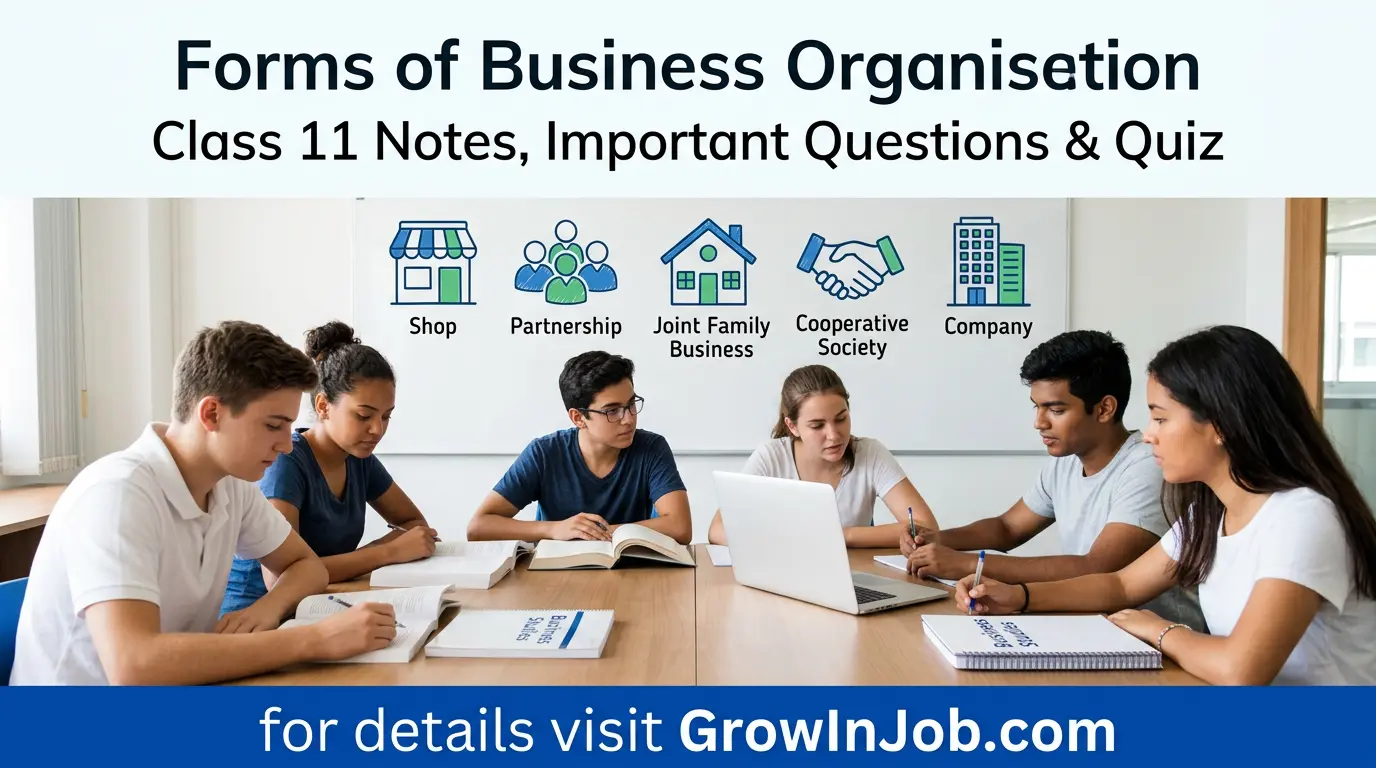

Forms of business organisation is a core topic in Class 11 Business Studies. It explains how different types of business units are owned, managed and controlled, and how this choice affects risk, profit, capital, and continuity.
This chapter covers:
- Meaning and types of forms of business organisation
- Features, merits and limitations of each form
- Factors affecting the choice of form of organisation
- Important questions (very short, short, long, assertion–reason, case-based and MCQs) for CBSE exams
What Are Forms of Business Organisation?
When starting or expanding a business, one of the most important decisions is choosing the appropriate form of business organisation. This decision affects:
- Ownership and control
- Sharing of profits and losses
- Liability of owners
- Continuity and stability
- Ability to raise capital
The main forms of business organisation in Class 11 syllabus are:
- Sole Proprietorship
- Joint Hindu Family Business
- Partnership
- Cooperative Society
- Joint Stock Company
Types of Business Organisation in Class 11 Syllabus
Sole Proprietorship – Meaning, Features, Merits and Demerits
Meaning
Sole proprietorship is a form of business organisation that is owned, managed and controlled by a single individual who alone bears all risks and enjoys all the profits. The word “sole” means only and “proprietor” means owner.
This form is common in:
- Neighbourhood shops
- Small retail stores
- Parlours and salons
- Small service businesses
Features of Sole Proprietorship
- Single owner: Business is owned and controlled by one individual.
- Easy formation and closure: Almost no legal formalities, except licences where required; closure is also simple.
- Unlimited liability: Owner’s personal assets can be used to pay business debts if business assets are insufficient.
- No separate legal entity: Law does not distinguish between owner and business.
- Sole risk bearer and profit recipient: All profits and losses belong to the owner alone.
- Complete control: Owner takes all decisions and manages operations independently.
- Lack of continuity: Death, insolvency, illness or insanity of the owner usually ends the business.
Merits of Sole Proprietorship
- Quick decision making because no consultation is required.
- Confidentiality of information as accounts are not legally required to be published.
- Direct incentive since the owner keeps all profits.
- Personal satisfaction and sense of accomplishment.
- Ease of formation and closure with minimal legal restrictions.
Limitations of Sole Proprietorship
- Limited financial resources restricted to personal savings and borrowings.
- Limited life of business due to full dependence on one person.
- Unlimited liability creating high personal financial risk.
- Limited managerial ability because one person must handle all functions.
Joint Hindu Family Business – Meaning, Features, Advantages and Limitations
Meaning
Joint Hindu Family Business is a form of organisation found only in India. It is carried on by the members of a Hindu Undivided Family (HUF) and is governed by Hindu Law. Membership is by birth, and up to three successive generations can be co-parceners.
The eldest member of the family is called karta, who manages the business. Other members are called co-parceners and jointly own the ancestral property.
Features of Joint Hindu Family Business
- Formation: Requires at least two members and ancestral property; no partnership agreement is needed.
- Membership by birth: Any person born into the HUF automatically becomes a member; minors can be co-parceners.
- Control by karta: Karta manages the business and takes all decisions on behalf of the family.
- Liability: Karta has unlimited liability; liability of co-parceners is limited to their share in the co-parcenary property.
- Continuity: Business continues even after karta’s death, as the next eldest member becomes karta.
Merits of Joint Hindu Family Business
- Effective control due to single decision-maker (karta), reducing conflict.
- Prompt and flexible decision making.
- Continued business existence despite death of karta.
- Limited liability for co-parceners, so their personal risk is limited.
- Greater loyalty and cooperation because the business is run by family members.
Limitations of Joint Hindu Family Business
- Limited resources since capital mainly comes from ancestral property.
- Unlimited liability and heavy responsibility on karta.
- Possibility of dominance and misuse of power by karta.
- Limited managerial skills if karta is not competent in all areas of management.
- Declining importance due to reduction in number of joint families.
Partnership – Meaning, Features, Merits, Demerits and Types
Meaning
Partnership is the relation between persons who have agreed to share the profits of a business carried on by all or any of them acting for all. It is governed by the Indian Partnership Act, 1932.
Essential elements:
- Agreement between two or more persons
- Lawful business
- Profit-sharing
- Mutual agency
Features of Partnership
- Formation by agreement: Oral or written agreement; written form called partnership deed.
- Governed by Indian Partnership Act, 1932.
- Unlimited liability: Partners’ personal assets may be used to pay business debts.
- Joint and several liability: Each partner is liable for firm’s debts and can later claim his share from others.
- Risk bearing: Profits and losses are shared in an agreed ratio.
- Joint decision making and control of business operations.
- Lack of continuity: Death, insolvency, retirement or insanity of any partner may dissolve the firm unless reconstituted.
- Number of partners: Minimum 2, and as per current rules, generally up to 50.
- Mutual agency: Each partner is both an agent and a principal; acts of one bind all.
Merits of Partnership
- Ease of formation and closure with simple agreement and optional registration.
- Balanced decision making due to combined skills and experience.
- More funds than sole proprietorship as many partners contribute capital.
- Sharing of risk reduces burden on individual partners.
- Greater secrecy as publishing accounts is not compulsory.
Limitations of Partnership
- Unlimited liability of partners.
- Limited resources due to restriction on number of partners.
- Possibility of conflicts and disputes due to difference in opinion.
- Lack of continuity as the firm may dissolve when a partner leaves or dies.
- Lack of public confidence due to limited disclosure of financial information.
Types of Partners in Partnership Firm
- Active partner: Contributes capital, takes part in management, shares profits and losses, and has unlimited liability.
- Sleeping or dormant partner: Contributes capital and shares profits and losses but does not participate in daily management; liability is unlimited.
- Secret partner: Participates in management and shares profits and losses, but his association is not known to the public; liability is unlimited.
- Nominal partner: Allows firm to use his name, does not contribute capital or share profits, does not manage business, but is liable to third parties.
- Partner by estoppel: By words or conduct gives impression of being a partner, though not actually one; becomes liable for firm’s debts to third parties.
- Partner by holding out: Knowingly allows others to represent him as a partner; if he does not deny, he becomes liable for firm’s debts to third parties.
Types of Partnership (Duration and Liability)
On the basis of duration:
- Partnership at will: No fixed duration; exists as long as partners desire; any partner can dissolve it by giving notice.
- Particular partnership: Formed for a specific project or period; dissolves automatically when that purpose is achieved or time is over.
On the basis of liability:
- General partnership: Liability of all partners is unlimited and joint; all can take part in management; registration is optional and existence is affected by partner changes.
- Limited partnership: Liability of at least one partner is unlimited, while others may have limited liability; limited partners do not manage the business; registration is compulsory.
Partnership Deed and Registration of Firm
A partnership deed is a written agreement that specifies the terms and conditions of partnership, such as:
- Name, nature and location of business
- Duration of partnership
- Capital contributed by each partner
- Profit and loss sharing ratio
- Duties and obligations of partners
- Provisions for salaries, interest on capital and drawings
- Rules for admission, retirement and expulsion
- Method of dispute resolution and dissolution
- Preparation and audit of accounts
Registration of a partnership firm is optional but advisable. It involves:
- Submitting an application with details of firm name, address, partners’ names and addresses, date of joining and duration.
- Paying the required fee.
- Registrar entering details in the Register of Firms and issuing a certificate of registration.
Consequences of non‑registration:
- A partner cannot sue the firm or other partners.
- The firm cannot sue third parties.
- The firm cannot sue its partners.
Cooperative Society – Meaning, Features, Advantages, Limitations and Types
Meaning
A cooperative society is a voluntary association of persons who come together to protect and promote their economic interests through mutual help and cooperation. It is registered under the Cooperative Societies Act, 1912 and follows the principle of “one man, one vote”.
Features of Cooperative Society
- Voluntary membership: Any person can join or leave as per his choice, subject to bye-laws.
- Compulsory registration and separate legal entity: Society can own property, enter into contracts, sue and be sued in its own name.
- Limited liability: Liability of members is limited to the amount of capital they contribute.
- Democratic control: Elected managing committee runs the society; each member has one vote.
- Service motive: Main objective is service, not profit, though surplus may be distributed as dividend according to rules.
Merits of Cooperative Society
- Equality in voting status based on one man, one vote.
- Limited liability of members.
- Stable existence unaffected by death, insolvency or insanity of members.
- Economy in operations due to elimination of middlemen and honorary services by members.
- Government support in the form of subsidies, tax concessions and low‑interest loans.
- Relative ease of formation through simple registration procedures.
Limitations of Cooperative Society
- Limited financial resources because members usually have limited means and dividends are low.
- Inefficient management as high‑quality professionals may not be attracted.
- Lack of secrecy due to open discussions and legal disclosure requirements.
- Excessive government control reducing operational freedom.
- Internal conflicts, group rivalries and political interference may hamper functioning.
Types of Cooperative Societies
- Consumers’ cooperative societies: Formed by consumers to obtain quality goods at fair prices by buying in bulk and eliminating middlemen; surplus is distributed to members.
- Producers’ cooperative societies: Formed by producers to procure raw materials, tools and equipment jointly and to market their output collectively.
- Marketing cooperative societies: Assist small producers in collection, grading, storage and sale of goods to secure better prices.
- Farmers’ cooperative societies: Farmers pool land or resources to carry out farming collectively and use modern inputs.
- Credit cooperative societies: Provide loans to members at reasonable interest rates and protect them from moneylenders.
- Cooperative housing societies: Help members acquire residential houses or plots at reasonable cost, often with instalment facilities.
Joint Stock Company – Meaning, Features, Merits and Limitations
Meaning
A joint stock company is an artificial person created by law, having a separate legal entity, perpetual succession and a common seal. It is formed to carry on business activities and is governed by the Companies Act.
Shareholders are owners of the company, while the Board of Directors and professional managers manage its affairs.
Features of a Company
- Artificial person created by law.
- Separate legal entity distinct from its members.
- Perpetual succession, unaffected by death, insolvency or insanity of members.
- Limited liability of members to the unpaid amount on shares held.
- Separation of ownership and management; run by Board of Directors and managers.
- Legal formation through registration under the Companies Act.
Merits of a Company
- Limited liability encourages investment by reducing owners’ risk.
- Large financial resources through issue of shares and debentures and borrowing from institutions.
- Perpetual existence provides stability and long‑term planning.
- Transferability of shares (in public companies) provides liquidity to shareholders.
- Professional management improves efficiency and division of work.
Limitations of a Company
- Complex and expensive formation with many legal formalities.
- Lack of secrecy due to compulsory disclosure and publication of accounts.
- Impersonal work environment and weak personal contact with employees and customers.
- Numerous legal regulations and compliance requirements.
- Delay in decision making due to multiple levels of management.
- Possibility of dominance by a small group of powerful shareholders or directors.
Types of Companies – Private Company and Public Company
Private Company:
- Minimum 2 and maximum 200 members (excluding employee-members).
- Restricts the right to transfer shares.
- Prohibits public invitation to subscribe to its securities.
- Must use the words “Private Limited” (Pvt. Ltd.) after its name.
- Can commence business immediately after obtaining certificate of incorporation.
Public Company:
- Minimum 7 members; no maximum limit.
- Shares are freely transferable (subject to law).
- Can invite public to subscribe to its securities via prospectus.
- Must use the word “Limited” after its name.
- Must obtain both certificate of incorporation and certificate of commencement of business before starting operations.
A private company which is a subsidiary of a public company is deemed to be a public company.
Comparative Study of Forms of Business Organisation (Class 11)
| Basis | Sole Proprietorship | Partnership | Joint Hindu Family | Cooperative Society | Company |
|---|---|---|---|---|---|
| Ownership | Single individual | Two or more partners | Members of HUF | Members of the society | Shareholders |
| Formation | Very simple, few formalities | Simple agreement, optional regn. | By status in family | Registration compulsory | Lengthy process under Companies Act |
| Liability | Unlimited | Unlimited, joint and several | Karta unlimited; others limited | Limited to capital contribution | Limited to unpaid share capital |
| Management | Owner manages | All or some partners manage | Karta manages | Elected managing committee | Board of Directors and managers |
| Continuity | Ends with owner’s death, etc. | Affected by partner changes | Continues with new karta | Stable due to separate entity | Perpetual succession |
| Capital | Limited personal resources | Partners’ combined resources | Mainly ancestral property | Members’ capital and government assistance | Large resources from public and institutions |
| Secrecy | High | High | Internal to family | Lower due to openness | Low due to statutory disclosure |
| Suitable scale | Very small to small | Small to medium | Traditional family business | Small/community‑based activities | Medium to very large‑scale operations |
Factors Affecting Choice of Form of Business Organisation
Key factors to consider while selecting a form of business organisation are:
- Cost and ease of formation – Sole proprietorship is easiest and cheapest; company is most complex and expensive to form.
- Liability – For lower personal risk, forms with limited liability (company and cooperative) are preferred; proprietorship and partnership involve unlimited liability.
- Continuity – If long‑term stable existence is important, company and cooperative society are more suitable than proprietorship and partnership.
- Capital requirements – Large capital needs favour the company form; small capital needs can be met by proprietorship or partnership.
- Managerial ability – Complex, large businesses needing professional management choose companies; simple businesses may run as proprietorships or partnerships.
- Degree of control – If full control is desired, proprietorship is best; shared control can be achieved through partnership; in company, control is indirect via shareholding and voting.
- Nature of business – Personal service businesses prefer proprietorship; large manufacturing or capital‑intensive businesses choose company form; welfare‑oriented activities often adopt cooperative form.
Forms of Business Organisation Class 11 – Important Questions and Answers
Very Short Answer Questions (1 Mark)
- Define sole proprietorship.
Sole proprietorship is a form of business organisation owned, managed and controlled by a single individual who is the sole recipient of all profits and bearer of all risks. - Who is a karta?
Karta is the eldest member of a Hindu Undivided Family who manages and controls the Joint Hindu Family business and has unlimited liability. - What is mutual agency in partnership?
Mutual agency means that each partner is both an agent and a principal, so the act of any partner, done in the ordinary course of business, binds all the partners and the firm. - State the voting principle in a cooperative society.
A cooperative society follows the principle of “one man, one vote”, regardless of the capital contribution by a member. - What is meant by limited liability?
Limited liability means that the liability of owners is restricted to the amount they have invested in the business and their personal assets are not used to pay business debts. - Name the document which contains the terms and conditions of partnership.
Partnership deed. - What is the minimum number of members required to form a public company?
Minimum 7 members. - Which form of business organisation has membership by birth?
Joint Hindu Family business. - Name the form of organisation most suitable when quick decisions and direct contact with customers are essential.
Sole proprietorship. - Which forms of organisation must be compulsorily registered?
Cooperative society and company.
Short Answer Questions (3–4 Marks)
- State any four limitations of sole proprietorship.
- Limited financial resources as capital mainly comes from the proprietor’s own savings and borrowings.
- Limited life of the business because it usually ends with the death, insolvency or illness of the owner.
- Unlimited liability, so personal assets may have to be sold to pay business debts.
- Limited managerial ability as one person has to look after all functions such as production, marketing and finance.
- Differentiate between a private company and a public company on any four points.
- Minimum members: Private company requires at least 2 members; public company requires at least 7 members.
- Maximum members: Private company can have up to 200 members; there is no maximum limit for a public company.
- Invitation to public: A private company cannot invite the public to subscribe to its shares; a public company can invite the public.
- Transfer of shares: Transfer of shares is restricted in a private company; in a public company, shares are freely transferable subject to legal provisions.
- What is meant by a cooperative society? State any two advantages and two limitations.
Meaning: A cooperative society is a voluntary association of persons who join together to protect and promote their economic interests through mutual help, registered under the Cooperative Societies Act, 1912. Advantages (any two):- Equality in voting due to the principle of one man, one vote.
- Limited liability of members, restricting their risk to the amount of capital contributed.
- Limited resources because members generally have limited means and returns are modest.
- Inefficiency in management since expert managers may not be attracted due to lower salaries.
- Distinguish between Joint Hindu Family business and partnership (any four points).
- Basis of membership: In Joint Hindu Family business, membership is by birth in a Hindu Undivided Family; in partnership, membership arises from a contract.
- Management: Joint Hindu Family business is managed by the karta; partnership is managed by all partners or any one acting for all.
- Liability: In Joint Hindu Family business, karta has unlimited liability while co-parceners have limited liability; in partnership, all partners have unlimited liability.
- Continuity: Joint Hindu Family business continues even after karta’s death as the next eldest becomes karta; partnership dissolves on the death, insolvency or insanity of a partner unless reconstituted.
- What is registration of a partnership firm? State any three consequences of non‑registration.
Registration of a partnership firm means entering the firm’s name and prescribed particulars in the Register of Firms kept with the Registrar of Firms. It provides legal recognition to the firm. Consequences of non‑registration (any three):- A partner of an unregistered firm cannot file a suit against the firm or other partners.
- An unregistered firm cannot file a suit against third parties.
- The firm cannot file a case against any of its partners.
- Name and explain any two types of cooperative societies.
- Consumers’ cooperative society: Formed by consumers to obtain quality goods at reasonable prices by purchasing in bulk from wholesalers or producers and selling to members. Surplus is distributed among members.
- Credit cooperative society: Formed to provide credit facilities to members at reasonable interest rates and protect them from exploitation by moneylenders.
- Explain any four features of a company.
- Separate legal entity: A company has a distinct legal identity separate from its members.
- Limited liability: Liability of shareholders is limited to the unpaid amount on shares held by them.
- Perpetual succession: Company continues to exist irrespective of changes in its membership.
- Artificial person: Created by law and can enter into contracts, own property, and sue or be sued in its own name.
Long Answer Questions (5–6 Marks)
- What do you understand by sole proprietorship? Explain its merits and limitations. Meaning: Sole proprietorship is a form of business organisation owned, managed and controlled by a single individual who alone bears all risks and enjoys all profits of the business. Merits (any four):
- Quick decision making: As the sole owner, the proprietor can take decisions quickly without consulting others, helping to seize market opportunities.
- Confidentiality of information: The proprietor is not legally required to publish accounts, so business secrets can be maintained easily.
- Direct incentive: Since the owner receives the entire profit, there is a strong incentive to work hard and manage the business efficiently.
- Ease of formation and closure: Few legal formalities are involved in starting or closing a sole proprietorship, making it convenient to operate.
- Limited resources: Capital is limited to the proprietor’s own funds and borrowings, restricting scope for expansion.
- Limited life of the business: The business usually ends with the death, insolvency, or incapacity of the proprietor.
- Unlimited liability: If business assets are insufficient, the proprietor’s personal property can be used to repay debts, increasing his risk.
- Limited managerial ability: One person cannot be expert in all business functions, which may lead to poor decisions and inefficiency.
- Explain the characteristics, merits and limitations of the cooperative form of organisation. Characteristics (any four):
- Voluntary membership: Individuals can join or leave a cooperative society voluntarily, subject to the society’s bye-laws.
- Compulsory registration: Registration is mandatory, giving the society a separate legal entity distinct from its members.
- Limited liability: Members’ liability is generally limited to the amount of capital they contribute.
- Democratic control: An elected managing committee runs the society, and each member has one vote regardless of capital contribution.
- Equality in voting: All members enjoy equal voting rights, promoting fairness and democracy.
- Stable existence: The society continues irrespective of the death, bankruptcy or insanity of members because of its separate legal status.
- Economy in operations: Elimination of middlemen and voluntary services from members help reduce costs.
- Government support: Cooperatives often receive benefits such as subsidies, low-interest loans and tax concessions.
- Limited resources: Capital is mainly drawn from members with limited means and returns are modest, restricting expansion.
- Inefficient management: Societies may not be able to afford expert managers, leading to weaker management.
- Lack of secrecy: Open meetings and statutory reporting make it difficult to maintain business secrecy.
- Government control and factionalism: Excessive regulation and internal conflicts can reduce efficiency.
- Discuss the factors that determine the choice of form of organisation. The following factors influence the choice of form of business organisation:
- Cost and ease of formation: If owners want a simple and inexpensive start, sole proprietorship or partnership is preferred. Company formation is complex and costly due to extensive legal formalities.
- Liability: Where owners want to limit their personal risk, forms like company and cooperative, with limited liability, are more suitable than sole proprietorship or partnership.
- Continuity: For businesses requiring long-term existence and stability, such as large industries, company and cooperative forms are more appropriate as they are not affected by changes in membership.
- Capital requirements: Businesses requiring large capital, such as large-scale manufacturing, need a company form that can raise funds from many investors. Small businesses with modest capital needs can choose proprietorship or partnership.
- Managerial ability: Complex businesses that need professional and specialised management prefer company form, whereas small businesses with limited complexity can be effectively managed as proprietorships or partnerships.
- Degree of control: Individuals who want full control over decisions may prefer sole proprietorship. Those willing to share control may opt for partnership or company, where control is shared or indirect through voting rights.
- Nature of business: Businesses requiring personal contact and trust, such as clinics or small retail, are suitable for proprietorship; organisations with social and welfare objectives may adopt the cooperative form; large commercial enterprises often choose the company form.
- Explain the features, merits and limitations of partnership. Features (any four):
- Formation by agreement: Partnership arises from a contract among persons who agree to share profits of a lawful business.
- Unlimited liability: Partners are liable to pay the firm’s debts even from their personal assets if necessary.
- Mutual agency: Each partner can act on behalf of the firm and bind other partners by his acts.
- Lack of continuity: Firm may dissolve on death, insolvency or retirement of a partner unless a new agreement is made.
- Ease of formation and closure: Partnership can be started or closed easily through mutual agreement.
- Balanced decisions: Partners with different skills share responsibilities, leading to more balanced and sound decisions.
- More financial resources: Several partners contribute capital, allowing the firm to undertake more activities than a sole proprietor.
- Sharing of risk: Business risk is shared among partners, reducing stress on any one individual.
- Unlimited liability: Partners’ personal assets are at risk, which may discourage risk‑taking.
- Limited capital: Despite multiple partners, capital resources are still limited compared to a company.
- Possibility of conflict: Differences in opinion may lead to disputes and inefficiency.
- Lack of public confidence: Public may not fully trust partnerships because they are not required to publish their accounts.
Assertion–Reason Questions (CBSE Pattern)
Directions: Choose the correct option:
A. Both Assertion (A) and Reason (R) are true, and R is the correct explanation of A.
B. Both Assertion (A) and Reason (R) are true, but R is not the correct explanation of A.
C. Assertion (A) is true, but Reason (R) is false.
D. Assertion (A) is false, but Reason (R) is true.
- Assertion (A): Sole proprietorship is suitable for small businesses where quick decisions are required.
Reason (R): In sole proprietorship, the owner does not have to consult anyone before taking decisions.
Answer: A - Assertion (A): In a cooperative society, members enjoy voting rights based on the capital they contribute.
Reason (R): Cooperative societies follow the principle of one man, one vote.
Answer: D - Assertion (A): A company has perpetual succession.
Reason (R): The death or insolvency of its members does not affect the existence of a company.
Answer: A - Assertion (A): In partnership, each partner has limited liability.
Reason (R): In partnership, the firm comes into existence by agreement among partners.
Answer: D - Assertion (A): Karta has unlimited liability in a Joint Hindu Family business.
Reason (R): Liability of co-parceners in Joint Hindu Family business is limited to their share in co-parcenary property.
Answer: B
Case-Based Questions (CBSE Pattern)
Case 1
Rohan runs a small bakery in his locality. He alone invests the capital, purchases raw materials, supervises workers, sells products to customers and keeps all the profits. Due to increasing demand, he wants to expand, but he finds it difficult to raise more funds. He is also worried that if losses occur, his personal car and house might be sold to pay off bakery debts.
Answer the following:
- Identify the form of business organisation in the above case.
Answer: Sole proprietorship. - State any two merits of this form of business evident from the case.
Answer:- Direct incentive as Rohan keeps all the profits.
- Quick decisions as he alone manages and controls the bakery.
- State any two limitations of this form of business evident from the case.
Answer:- Limited financial resources, making expansion difficult.
- Unlimited liability, as his personal assets like car and house may be used to pay business debts.
Case 2
A group of farmers in a village are unhappy with low prices offered by middlemen. They decide to form an organisation where they pool their savings, buy fertilisers and seeds in bulk, use tractors jointly and sell their produce collectively to large buyers. Each member has one vote in decision making irrespective of the amount he has contributed.
Answer the following:
- Identify the form of business organisation described above.
Answer: Cooperative society (farmers’ cooperative society). - State any two characteristics of this form of organisation evident from the case.
Answer:- Voluntary association of persons to promote their economic interests.
- Democratic control based on one man, one vote principle.
- Explain one merit of this form of organisation shown in the case.
Answer:- Economy in operations by purchasing inputs in bulk and marketing produce collectively, thus securing better prices.
Case 3
Neha starts an artwork business from home and operates as a sole proprietor. With increasing demand, she requires more funds and help in management. Her father suggests that she should bring in her cousin as a partner so that risks and responsibilities are shared. He also mentions that if the business grows further, she can convert it into a company to raise more capital from the public.
Answer the following:
- Which two forms of business organisation are being suggested to Neha besides sole proprietorship?
Answer: Partnership and company. - Why is partnership suggested as the next step?
Answer: Partnership will provide additional capital, sharing of responsibility and sharing of risks between Neha and her cousin. - Why is the company form suggested for further expansion?
Answer: The company form can raise large amounts of capital from many investors and has better continuity and growth potential.
CBSE-Style MCQs on Forms of Business Organisation (With Answers)
- Sole proprietorship is most suitable for:
a) Large-scale manufacturing units
b) Small retail shops
c) Multinational corporations
d) Public utilities
Answer: b) Small retail shops - In a Joint Hindu Family business, membership is based on:
a) Agreement
b) Registration
c) Birth in the family
d) Purchase of shares
Answer: c) Birth in the family - The maximum number of members in a private company (as per current provisions) is:
a) 50
b) 100
c) 200
d) Unlimited
Answer: c) 200 - Which of the following features is common to both partnership and Joint Hindu Family business?
a) Membership by birth
b) Unlimited liability of all members
c) Separate legal entity
d) Sharing of profits among members
Answer: d) Sharing of profits among members - Which principle is followed in a cooperative society for voting rights?
a) One share, one vote
b) One rupee, one vote
c) One man, one vote
d) One director, one vote
Answer: c) One man, one vote - The document that contains the internal rules of a partnership firm is called:
a) Memorandum of Association
b) Articles of Association
c) Partnership deed
d) Prospectus
Answer: c) Partnership deed - The liability of shareholders in a company is:
a) Unlimited
b) Limited to unpaid amount on shares
c) Limited to total assets of the company
d) Non‑existent
Answer: b) Limited to unpaid amount on shares - Which of the following forms of organisation has a separate legal entity?
a) Sole proprietorship
b) Partnership
c) Joint Hindu Family business
d) Company
Answer: d) Company - In which form of organisation is registration compulsory?
a) Sole proprietorship
b) Partnership
c) Cooperative society
d) Joint Hindu Family business
Answer: c) Cooperative society - Who manages the business in a Joint Hindu Family business?
a) All co-parceners jointly
b) Elected board
c) Karta
d) Government
Answer: c) Karta
Student Resources and Practice for Class 11
To strengthen your foundation in Business Studies and boost your exam performance, you should regularly revise notes and solve quality practice questions.
For more Class 11 chapter notes, important questions and interactive quizzes, visit the dedicated Student Zone on GrowInJob. GrowInJob is a career platform that believes excellence in any job starts with a strong foundation in school. Their Student Zone offers structured chapter-wise resources to support your learning journey: https://growinjob.com/category/student-zone/