
Accounting is a systematic process of recording, classifying and summarising business transactions to provide useful financial information to different users. For Class XI students, understanding the objectives of accounting builds the base for all further chapters and exams.
Introduction: What Is Accounting?
Accounting is the process of identifying, measuring, recording and communicating economic information (transactions that can be measured in money) about a business. It is often called the “language of business” because it communicates the financial results and position of an organisation to owners, managers and other interested parties.
For Class 11, the prescribed text in Chapter 1: Introduction to Accounting explains that accounting helps in keeping systematic records, determining profit or loss, depicting financial position and providing information to various users.
Objectives of Accounting
“Objectives of accounting” means the main aims for which accounts are maintained in a business. In simple words, why do we do accounting at all, and what do we want to achieve by preparing journals, ledgers, trial balance and final accounts.
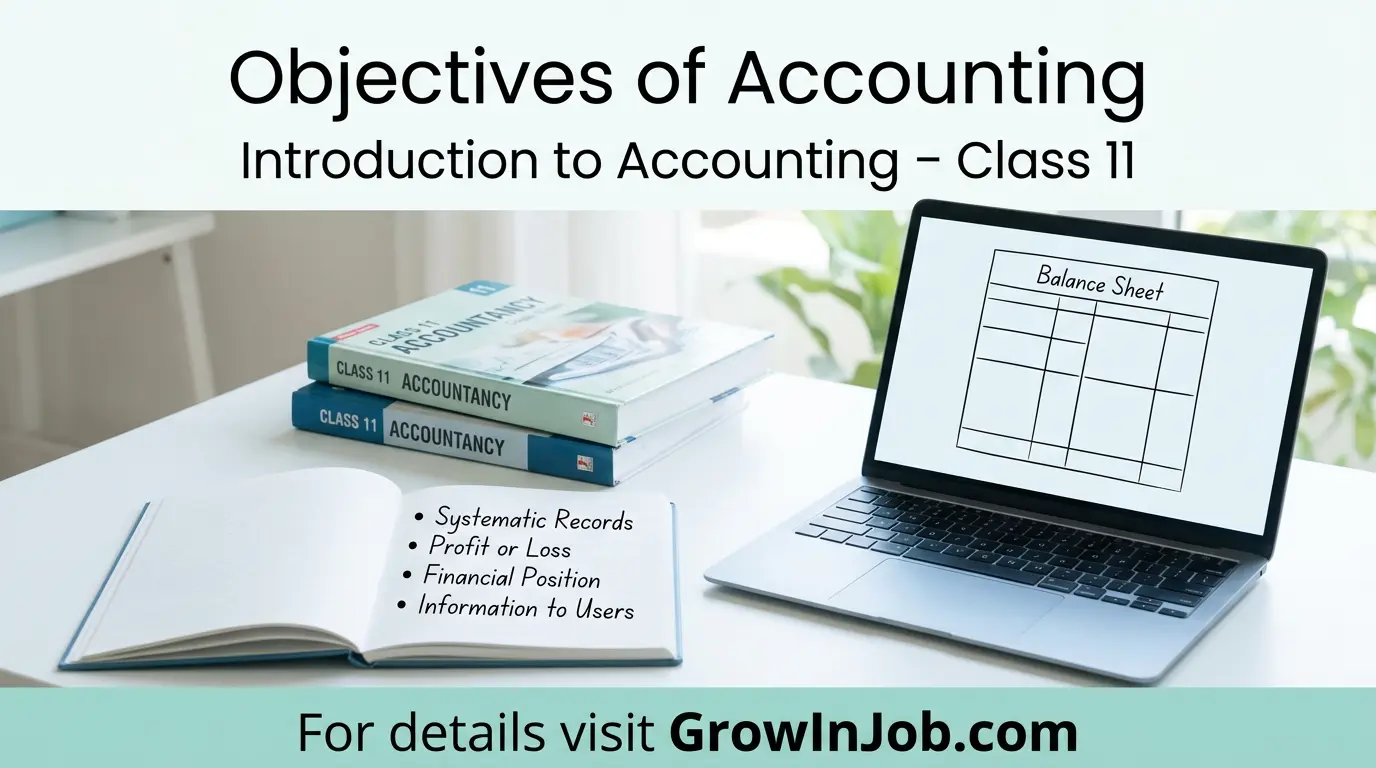
According to the Class 11 syllabus, the primary objectives of accounting are:
- Maintenance of systematic records of business transactions
- Calculation of profit or loss
- Depiction of the financial position
- Providing accounting information to various users for decision-making
Objective 1: Maintenance of Systematic Records
A business undertakes numerous transactions every day such as purchases, sales, receipts and payments, which no owner or manager can remember accurately for long. Accounting provides a systematic record of all these financial transactions in the books of original entry and ledgers, following specified rules and principles.
By recording every transaction with date, amount and proper classification, accounting helps avoid omissions, duplications and fraudulent manipulation. These records also act as evidence for future reference, for example when settling disputes with customers, suppliers or tax authorities.
Objective 2: Calculation of Profit or Loss
Every proprietor wants to know whether the business activities during an accounting period have resulted in a profit or a loss. Accounting helps to determine this by recording all revenues (like sales, commission received) and expenses (like purchases, wages, rent, depreciation) for the year and then preparing the Trading and Profit & Loss Account.
Profit is calculated as the excess of total revenues over total expenses for a specific period, while loss is the excess of total expenses over total revenues. This information helps owners assess how well the business has performed and whether its policies and strategies are working.
Objective 3: Depiction of Financial Position
Apart from knowing profit or loss, it is equally important to know the financial position of the business on a particular date. For this purpose, a Balance Sheet (statement of financial position) is prepared showing all assets (resources owned) and liabilities (obligations owed) and owners’ capital at the end of the accounting year.
The Balance Sheet gives a snapshot of what the business owns and what it owes, helping to judge its solvency, liquidity and overall strength. For example, high debts with low working capital may indicate financial risk, while strong assets and low liabilities indicate a sound financial position.
Objective 4: Providing Information to Users
Accounting acts as an information system that collects, processes and communicates financial data to various internal and external users. Internal users include owners, managers and employees, while external users include investors, creditors, banks, government, tax authorities and the public.
Each user group relies on accounting information for different decisions, such as investing, lending, granting credit, taxation, wage negotiations or planning future activities. Thus, another major objective of accounting is to provide relevant, reliable, understandable and comparable information for decision-making.
Other Important Objectives and Functions
Besides the four primary objectives, Class 11 notes and guides also highlight some additional objectives and functions of accounting.
- Protecting assets: Maintaining proper records of cash, stock, debtors and other assets helps in safeguarding them and preventing misuse, errors and fraud.
- Compliance with legal requirements: Accounting supports preparation of financial statements and other reports required by law, tax authorities and regulators.
- Facilitating comparison and evaluation: Properly prepared accounts allow comparison of results over different years and with other firms, helping to assess growth and performance.
- Assisting in planning and control: Accounting information (like cost data, budgets and variance reports) helps management in planning for the future and controlling current operations.
Qualitative Characteristics of Accounting Information
To achieve its objectives, accounting information must possess certain qualitative characteristics.
Reliability
Information should be free from significant error and bias and be based on verifiable evidence like bills and vouchers.
Relevance
Information must be timely and useful for prediction and feedback, influencing users’ decisions.
Understandability
Reports should be presented clearly so that users can interpret them in the intended sense.
Comparability
Use of consistent methods, common units and formats enables comparison over time and across firms.
These characteristics ensure that accounting truly serves its objective of being a dependable source of information for students, teachers, business owners and other users.
Why Objectives of Accounting Matter for Class XI Students
For Class XI commerce students, objectives of accounting are frequently tested in exams as short-answer, long-answer and MCQ-type questions. Knowing them clearly also helps in understanding later topics such as financial statements, accounting concepts and conventions, and the role of different users of accounting information.
An easy way to revise is to remember the four core objectives in order:
- Maintain systematic records,
- Calculate profit or loss,
- Depict financial position,
- Provide information to users.
Quiz
Test your understanding with the interactive quiz below, and quickly check how well you remember the key concepts and terms.
Question Bank – Objectives of Accounting
Very Short Answer Questions (1 mark)
- Define accounting in one sentence.
Accounting is the process of identifying, measuring, recording and communicating financial information of business transactions. - State any one primary objective of accounting.
One primary objective is to maintain systematic records of business transactions. - Which financial statement shows the financial position of a business?
The Balance Sheet shows the financial position of a business. - What is profit in accounting?
Profit is the excess of total revenues over total expenses for a particular period. - Name any one internal user of accounting information.
Managers are an internal user of accounting information. - Name any one external user of accounting information.
Investors are an external user of accounting information. - Which qualitative characteristic of accounting information is related to “no bias and error”?
Reliability. - What is meant by ‘systematic record’ in accounting?
It means recording all business transactions in a proper, orderly and chronological manner. - Which objective of accounting is achieved by preparing the Profit & Loss Account?
The objective of calculating profit or loss. - Which objective of accounting is achieved by preparing the Balance Sheet?
The objective of depicting the financial position.
Short Answer Questions (2–3 marks)
- State any two primary objectives of accounting.
- To maintain systematic and complete records of all business transactions.
- To ascertain profit or loss of the business for a particular accounting period.
- How does accounting help in decision-making?
Accounting provides financial information about revenues, expenses, assets and liabilities. This helps owners, managers and other users to take decisions such as pricing, cost control, expansion, investment and financing. - Differentiate between profit and loss.
Profit occurs when total revenues exceed total expenses in an accounting period, increasing the owner’s equity. Loss occurs when total expenses exceed total revenues, decreasing the owner’s equity. - Explain the objective of ‘maintenance of systematic records’.
A business has numerous daily transactions which cannot be remembered correctly. Accounting records all financial transactions in books like journals and ledgers systematically, so that information is complete, accurate and available for reference. - What is meant by ‘depiction of financial position’?
It is an objective of accounting under which the business prepares a Balance Sheet on a particular date showing assets, liabilities and capital, so that the solvency and overall financial strength can be known. - State any two examples of internal users and any one example of external user of accounting information.
Internal users: owners, managers. External user: bank, investor, creditor, government, etc. - Explain the term ‘relevance’ as a qualitative characteristic of accounting information.
Relevance means the information should be capable of influencing decisions by helping users to predict outcomes or confirm past evaluations and must be available in time. - Explain the term ‘comparability’.
Comparability means users can compare financial information over different periods and with other enterprises because common accounting methods, units and formats are used consistently. - Why is accounting called the “language of business”?
Because it communicates the financial results and financial position of a business to various users through reports and statements, just as language communicates ideas. - How does accounting help in protecting business assets?
Accounting keeps proper records of assets (cash, stock, machinery, etc.), which helps in controlling their use, detecting losses or pilferage and fixing responsibility for safeguarding them.
Short / Medium Answer Questions (3–4 marks)
- Explain any three objectives of accounting.
- Maintenance of records: To keep complete, systematic records of all financial transactions so that information is not lost and can be verified.
- Calculation of profit or loss: To determine the net result of business operations for a particular period by preparing Trading and Profit & Loss Account.
- Depiction of financial position: To show the financial position on a particular date by preparing a Balance Sheet showing assets, liabilities and capital.
- How does accounting information serve different users? Give examples.
Owners use it to know profitability and capital. Managers use it for planning, control and decision-making. Investors and creditors use it to judge safety and return of their funds. Government and tax authorities use it for taxation and regulatory purposes. Employees and unions use it for wage negotiations and job security. - What is meant by ‘qualitative characteristics’ of accounting information? Name any four.
Qualitative characteristics are the attributes that make accounting information useful for users. Four main characteristics are reliability, relevance, understandability and comparability. - Explain the role of accounting in business.
Accounting helps in recording transactions, determining profit or loss, showing financial position, ensuring control over assets and resources, complying with legal requirements and providing information to various users for decision-making and planning. - Why can only transactions measurable in money be recorded in accounting?
Accounting uses money as a common unit of measurement. Therefore, only those events that can be expressed in monetary terms and have happened are recorded. Non-monetary factors like employee skills, brand loyalty or working conditions, though important, are not recorded because they cannot be measured reliably in money terms.
Long Answer Questions (5–8 marks)
- Discuss in detail the primary objectives of accounting.
The primary objectives of accounting are:- Maintenance of systematic records: A business undertakes numerous transactions daily. Accounting records them in a systematic manner in books of original entry and ledgers, preventing omissions and duplications and providing evidence for future reference.
- Calculation of profit or loss: Owners need to know whether business activities during an accounting period have resulted in profit or loss. Accounting collects all revenues and expenses and prepares the Trading and Profit & Loss Account to determine the net result.
- Depiction of financial position: At the end of the year, accounting helps prepare a Balance Sheet showing all assets, liabilities and capital, which depicts the solvency and overall financial strength of the business.
- Providing information to users: Accounting works as an information system. It processes data and provides useful reports to different users—owners, management, investors, creditors, government, etc.—to assist them in their decisions.
- Explain how accounting functions as an information system and how this relates to its objectives.
Accounting collects data about business transactions, measures them in monetary terms and records them in a systematic manner. The data is then classified, summarised and presented in the form of financial statements and reports. This whole process converts raw data into useful information. This directly supports the objectives of accounting: maintaining records, calculating profit or loss, depicting financial position and supplying relevant, reliable and comparable information to internal and external users for decision-making. - Describe the qualitative characteristics of accounting information and explain why they are important for fulfilling the objectives of accounting.
- Reliability: Information must be free from significant error and bias and based on verifiable evidence, so that users can trust it while taking decisions.
- Relevance: Information should influence decisions by helping users predict outcomes or confirm past events, and must be available in time.
- Understandability: Information should be presented clearly and simply so that users with reasonable knowledge can understand it.
- Comparability: Information should be prepared using consistent principles and formats so that users can compare performance over time and across firms.
These characteristics ensure that the information generated by accounting actually serves its objectives of guiding users, showing true performance and position, and helping in planning and control.
- Explain the role of accounting in meeting the information needs of: (i) owners, (ii) lenders, and (iii) government.
- Owners: They are interested in profitability, financial strength and growth. Accounting provides them with the Profit & Loss Account, Balance Sheet and other reports showing profits, capital and reserves.
- Lenders (banks and other creditors): They want to know whether the business will be able to repay principal and interest. Accounting information about cash flows, assets, liabilities and profitability helps them assess creditworthiness.
- Government and tax authorities: They require information for levying taxes, framing policies and ensuring compliance with laws. Accounting provides legally compliant financial statements on the basis of which tax liability and other dues are calculated.
- “Accounting is a means to an end, not an end in itself.” Explain this statement with reference to the objectives of accounting.
This statement means that the purpose of accounting is not just to prepare books and statements but to provide useful information. Accounting records, classifies and summarises transactions so that users can know the profit or loss, assess the financial position and make informed decisions. In other words, accounting is a tool or means to achieve the broader objective of decision-making, planning and control; it is not the final goal.
Case Study Type / Application Questions
- Case Study 1
A small trader, Meera, runs a stationery shop. She does not maintain proper accounting records and relies only on memory. At the end of the year, she is unable to say exactly how much she earned, how much stock is left or how much she owes to suppliers.Questions:
a) Which objectives of accounting are not being fulfilled in Meera’s business?
b) How can maintaining proper accounting records help her in future?Answers:
a) The objectives not being fulfilled are: maintenance of systematic records, calculation of profit or loss, depiction of financial position and providing reliable information to users.
b) Proper records will help Meera know her exact profit or loss, the value of closing stock, amounts payable to suppliers and receivable from customers. This will improve her control over business and support better decisions about pricing, purchases and expansion. - Case Study 2
A company’s Balance Sheet shows high long-term loans and very low current assets. The Profit & Loss Account shows good profits for the year. A bank is deciding whether to give the company an additional short-term loan.Questions:
a) Which users of accounting information are involved here?
b) Which objective of accounting is mainly helping the bank in taking a decision?Answers:
a) The users are external users—primarily the bank (lender) and also the company’s owners and other creditors.
b) The objective of depicting the financial position through the Balance Sheet, along with profit information, helps the bank assess the company’s solvency and liquidity before giving a loan. - Case Study 3
A firm prepares very detailed and accurate financial statements, but it finalises them 8–9 months after the end of the accounting year. Investors complain that the reports are not helpful for timely decisions.Questions:
a) Which qualitative characteristic is lacking here?
b) How does this affect the objectives of accounting?Answers:
a) Timely relevance is lacking. The information is reliable but not released in time, so its relevance is reduced.
b) Because of delay, accounting fails to fully achieve its objective of providing useful information to users for decision-making when they actually need it. - Case Study 4 – Objectives and Users of Accounting
Ravi started a small electronics shop on 1st April. During the year, he made both cash and credit sales, purchased goods on credit, paid rent, salaries and electricity, and bought some furniture for the shop. At year‑end, he wants to know:
whether he earned a profit or suffered a loss,
how much he owes to suppliers,
how much his customers owe him, and
what his shop is worth financially.
His bank has also asked for his financial statements before deciding on a small business loan.
Questions:
a) Identify any three objectives of accounting that are useful for Ravi in this situation.
b) Name two internal and two external users of accounting information in this case.
c) Which financial statement will help the bank the most in judging Ravi’s financial position?
d) How does accounting help Ravi in taking decisions for the next year?
Suggested Answers:
a) Objectives:
Maintenance of systematic records of all business transactions.
Calculation of profit or loss for the year.
Depiction of financial position through a Balance Sheet.
b) Internal users: Ravi (owner), any manager/employee he appoints.
External users: Bank (lender), suppliers (creditors).
c) The Balance Sheet (Statement of Financial Position) will help the bank most in judging assets, liabilities and capital.
d) Accounting helps Ravi analyse which products are profitable, how much credit he can safely allow, whether expenses are under control and whether he should expand, change pricing or reduce costs. - Case Study 5 – Qualitative Characteristics and Timeliness.
A company, Bright Textiles Ltd., prepares very detailed and accurate financial statements every year. However, due to delay in finalisation and audit, the statements for the year ending 31st March are usually made available to shareholders in January of the next year. Many shareholders complain that the information is too late to be useful for making investment decisions.
Questions:
a) Which qualitative characteristic of accounting information is mainly lacking here?
b) Explain how this affects one of the main objectives of accounting.
c) If the company starts issuing quarterly financial summaries within one month of each quarter, which qualitative characteristics will improve?
d) Name any two external users (other than shareholders) who may be affected by such delays.
Suggested Answers:
a) Timely relevance is lacking. The information is reliable but not available in time.
b) This reduces the objective of providing useful information for decision‑making because outdated reports cannot effectively guide investment or lending decisions.
c) Relevance (due to better timeliness) and comparability (more frequent, consistent information) will improve.
d) Two external users: potential investors, banks and other lenders, government or tax authorities. - Case Study 6 – Money Measurement and Limitations
XY Traders has highly skilled employees and an excellent brand reputation in the market. The firm pays salaries, rent, interest, electricity and other expenses regularly and also owns machinery, vehicles and computers. At the end of the year, its financial statements show assets, liabilities, income and expenses, but there is no figure for employees’ skills or brand reputation, even though these matter a lot for the business.
Questions:
a) Why are employees’ skills and brand reputation not shown as assets in traditional accounting records?
b) Which concept/limitation of accounting is highlighted by this situation?
c) Does this mean that accounting information is useless for users? Explain in one or two lines.
d) In spite of this limitation, mention any two objectives of accounting that are still fulfilled by the financial statements.
Suggested Answers:
a) They are not shown because they cannot be measured reliably in monetary terms under conventional accounting methods.
b) This highlights the money measurement concept and the limitation that accounting records only those items which can be expressed in money.
c) No. Accounting information is still very useful for users to know profits, financial position, liquidity etc., but it does not capture all non‑monetary factors.
d) Objectives fulfilled:- Calculation of profit or loss for the year.
- Depiction of financial position through assets, liabilities and capital, and providing useful information to users.
- Case Study 7 – CBSE‑Pattern Case with Sub‑Parts
Smart Foods Pvt. Ltd. prepares its books of account regularly. At the end of the year, the accountant provides the following information:- Total sales (cash and credit) and total expenses for the year.
- List of assets such as building, machinery, stock, debtors and cash.
- List of liabilities such as bank loan, creditors and outstanding expenses.
- Comparative figures of last year’s profit and important ratios.
The management uses this information to decide about opening a new branch, increasing advertisement and taking an additional bank loan. The bank also studies the financial statements before approving the loan.
Questions: - a) Name the two main financial statements that the accountant must have prepared to provide the above information.
- b) Which objectives of accounting are being achieved by these statements? (Write any three.)
- c) Identify two internal and two external users in this case.
- d) State any two qualitative characteristics of accounting information that are important for the bank while analysing the statements.
Suggested Answers:
a) The Profit & Loss Account (or Statement of Profit and Loss) and the Balance Sheet.
b) Objectives achieved:- Calculation of profit or loss for the year.
- Depiction of financial position at year‑end.
- Providing information to various users for decision‑making and planning.
c) Internal users: management, directors.
External users: bank (lender), shareholders or prospective investors.
d) Two qualitative characteristics: reliability (free from bias and based on evidence) and relevance (timely and useful for decision‑making); comparability can also be mentioned.
Assertion–Reason Type Questions (CBSE Style)
38. AR Question 1
Assertion (A): One of the primary objectives of accounting is to ascertain profit or loss for a particular period.
Reason (R): Profit or loss is calculated by comparing total assets with total liabilities of the business.
a) Both A and R are true, and R is the correct explanation of A
b) Both A and R are true, but R is not the correct explanation of A
c) A is true, but R is false
d) A is false, but R is true
Answer: c
Explanation: The objective is correctly stated in A, but profit or loss is found by comparing revenues and expenses, not by comparing assets and liabilities.
39. AR Question 2
Assertion (A): Accounting information must be comparable so that users can study performance over different years.
Reason (R): Comparability is achieved by using common accounting methods and formats consistently over time.
a) Both A and R are true, and R is the correct explanation of A
b) Both A and R are true, but R is not the correct explanation of A
c) A is true, but R is false
d) A is false, but R is true
Answer: a
Explanation: Users compare performance across periods only when methods and formats are consistent, so R correctly explains A.
40. AR Question 3
Assertion (A): Government and tax authorities are internal users of accounting information.
Reason (R): They use accounting information for levying taxes and framing economic policies.
a) Both A and R are true, and R is the correct explanation of A
b) Both A and R are true, but R is not the correct explanation of A
c) A is true, but R is false
d) A is false, but R is true
Answer: d
Explanation: Government and tax authorities are external users, not internal, but they do use accounting information for taxes and policies.
41. AR Question 4
Assertion (A): Accounting is called the language of business.
Reason (R): It communicates the financial results and financial position of the business to various users through reports and statements.
a) Both A and R are true, and R is the correct explanation of A
b) Both A and R are true, but R is not the correct explanation of A
c) A is true, but R is false
d) A is false, but R is true
Answer: a
Explanation: Accounting communicates business information in a structured way, so R correctly explains why it is called the language of business.
42. AR Question 5
Assertion (A): Reliability of accounting information means it should be available in time to influence decisions.
Reason (R): Timeliness is one of the key components of reliability.
a) Both A and R are true, and R is the correct explanation of A
b) Both A and R are true, but R is not the correct explanation of A
c) A is true, but R is false
d) A is false, but R is true
Answer: d
Explanation: Timeliness relates to relevance, not reliability. Reliability focuses on freedom from error and bias and verifiability.
Competency‑Based / Higher Order Case Questions
Competency Case 1 – Selecting Appropriate Information
A proprietor, Ayesha, has the following needs at year‑end:
She wants to know if the business has earned profit or suffered loss.
She wants to know the total value of assets, liabilities and her capital.
She wants to compare this year’s performance with last year.
She wants to apply for a bank loan, and the bank is asking for reliable and unbiased information.
Questions:
a) Which two main financial statements will satisfy needs (1) and (2)?
b) Which qualitative characteristics of accounting information are especially important for needs (3) and (4)?
c) State any two objectives of accounting that are directly fulfilled by these statements.
Suggested Answers:
a)
(1) Profit & Loss Account (Statement of Profit and Loss).
(2) Balance Sheet (Statement of Financial Position).
b)
For (3): Comparability (to compare current and previous year).
For (4): Reliability (true and fair, free from bias) and also relevance.
c)
Calculation of profit or loss for the period.
Depiction of financial position on a particular date.
Competency Case 2 – Classifying Users and Objectives
Read the following statements related to a business:
Bank wants to know whether to extend further credit facilities.
Employees’ union wants to see if the company can afford a wage increase.
Management wants to decide whether to close an unprofitable branch.
Government wants to determine the amount of income tax payable.
Questions:
a) Classify each as internal or external user of accounting information.
b) For any two of the above, write one accounting objective that helps that user’s decision.
Suggested Answers:
a)
Bank – External user.
Employees’ union – External user.
Management – Internal user.
Government – External user.
b) Examples:
Bank: Objective of depicting financial position and providing information on solvency and liquidity.
Employees’ union: Objective of calculating profit or loss and showing financial position to judge the firm’s ability to pay higher wages.
Management: Objectives of calculating profit or loss and providing detailed information for planning and control.
Government: Objective of providing standardised information to determine tax liability.
Competency Case 3 – Linking Objectives, Statements and Users
The following table contains jumbled items relating to accounting:
| Column I (Objectives): | Column II (Statements/Reports): | Column III (Users): |
| (i) To know profit or loss (ii) To know financial position (iii) To provide information to users | (a) Balance Sheet (b) Profit & Loss Account (c) Published financial statements and notes | (p) Shareholders and investors (q) Management (r) Government and tax authorities |
Questions:
a) Match each objective in Column I with the most suitable item in Column II.
b) For each pairing in part (a), name any one user from Column III who is likely to rely most on that information.
c) Explain in one line how this matching shows that accounting is an information system.
Suggested Answers:
a)
(i) To know profit or loss → (b) Profit & Loss Account (ii) To know financial position → (a) Balance Sheet (iii) To provide information to users → (c) Published financial statements and notes
b) Possible answers:
Profit & Loss Account → Shareholders and investors (p), management (q).
Balance Sheet → Shareholders and investors (p), government and tax authorities (r), management (q).
Published financial statements and notes → Shareholders and investors (p), government and tax authorities (r).
c) It shows that accounting converts transaction data into structured reports (statements) that serve the information needs of various users for decision‑making.