
A fingerprint on a glass, a strand of hair on a jacket, nail scrapings, a blood sample, or even a deleted mobile message — in real investigations, such small details often decide whether a crime is solved or remains unanswered.
The professionals who collect, examine, and scientifically interpret these clues belong to the field of forensic science. It is a discipline built on logic, technology, and core sciences, where evidence speaks louder than opinions.
As courts increasingly rely on scientific proof rather than statements alone, forensic science has become one of the most important pillars of modern criminal justice — and a serious career option for science students.
What Is Forensic Science?
Forensic science is the scientific investigation of evidence related to crimes so that facts can be presented objectively before the law. It applies principles of physics, chemistry, biology, computer science, and medicine to analyze materials collected from crime scenes.
Forensic experts do not work on assumptions or guesses. They rely on measurable, testable, and verifiable data, such as DNA profiles, toxicology reports, ballistic matches, chemical residues, and digital records. Because of this accuracy, forensic evidence carries strong weight in courts.
In India, the importance of forensic science has increased further after the introduction of the Bharatiya Nyaya Sanhita (BNS), which mandates forensic investigation in serious criminal cases. This has significantly increased the demand for trained forensic professionals across the country.
What Do Forensic Scientists Actually Do?
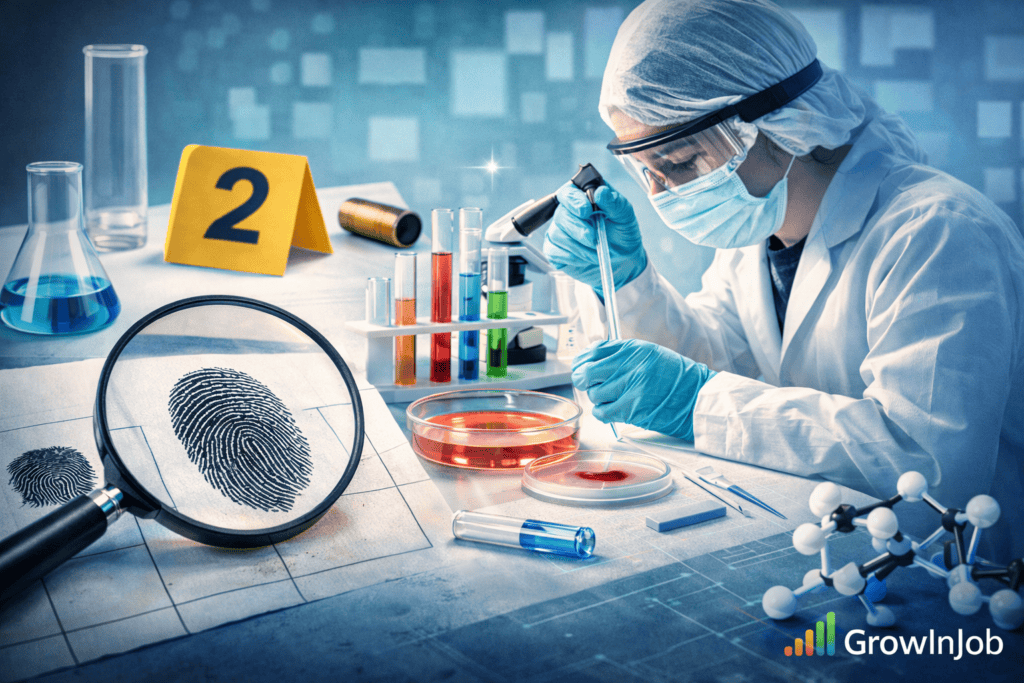
Forensic scientists usually work in laboratories and forensic units, supporting police and investigative agencies. Their work begins after evidence is collected from a crime scene or submitted by investigating officers.
They examine physical, biological, chemical, and digital evidence using scientific methods. After analysis, they prepare detailed forensic reports explaining what the evidence reveals and how the conclusions were reached. These reports help police officers, lawyers, and judges understand what actually happened and often play a decisive role in criminal trials.
Accuracy, patience, and careful documentation are essential, as even small errors can affect legal outcomes.
Major Branches of Forensic Science
Forensic science is a broad field with several specialized branches.
Forensic biology focuses on the analysis of DNA, blood, hair, saliva, and tissues. Forensic chemistry deals with drugs, explosives, poisons, and chemical residues. Forensic pathology determines the cause and time of death through post-mortem examinations. Forensic toxicology identifies alcohol, drugs, and poisons present in the human body.
With the rise of technology, digital and cyber forensics has become one of the fastest-growing areas, involving the investigation of mobile phones, computers, hacking incidents, and cybercrime. Other branches include forensic anthropology, which studies skeletal remains, and forensic odontology, which uses dental evidence for identification.
Where Do Forensic Science Professionals Work?
Forensic professionals are required across government departments and private organizations.
In India, major employers include Central and State Forensic Science Laboratories (CFSL and FSL), police departments, Crime Investigation Department (CID), Central Bureau of Investigation (CBI), Intelligence Bureau (IB), cybercrime cells, and court laboratories.
Outside government agencies, forensic experts also work with private forensic laboratories, cybersecurity firms, investigative agencies, insurance companies, banks, IT firms, food safety laboratories, universities, and legal consultancies.
How to Study Forensic Science
Eligibility After Class 12
To study forensic science, students generally need to complete Class 12 with Physics, Chemistry, and Biology or Mathematics. Most colleges require at least 50% marks, though eligibility criteria may vary.
Admissions to forensic science programs may be through university-level entrance exams, national tests like CUET, or merit-based selection, depending on the institution.
Courses in Forensic Science
The most common undergraduate course is BSc in Forensic Science. Some students also enter the field through related science degrees such as biology or chemistry.
Postgraduate options include MSc in Forensic Science and specialized postgraduate diplomas or certificate courses in areas like forensic toxicology, DNA analysis, and cyber forensics. Students interested in research or teaching can pursue a PhD in Forensic Science.
Top Forensic Science Institutions in India
Well-known institutions offering forensic science programs include the National Forensic Sciences University (NFSU), Institute of Forensic Science Mumbai, Banaras Hindu University (BHU), Osmania University, and several reputed private universities. Admissions may be through entrance exams, merit-based selection, or national tests such as CUET.
👉 Want to know about CUET? Check. https://growinjob.com/prepare-for-cuet-alongside-board-exams-complete-strategy-for-class-12-students/
Importance of Practical Training
Forensic science is a practical field. Internships, laboratory training, and hands-on experience with real evidence are extremely important. Employers prefer candidates who understand actual forensic procedures, not just theory.
Is Forensic Science Right for You After Class 12?
Forensic science is a good choice for students who enjoy science, problem-solving, and real-world applications. You do not need to be a topper, but you must be patient, observant, and comfortable working with facts rather than assumptions.
This career suits students who can work methodically, pay attention to detail, and remain objective under pressure.
👉 Engineering in mind? Read our JEE Main vs JEE Advanced 2026 Guide to understand exam differences and future scope. https://growinjob.com/jee-main-vs-jee-advanced-a-complete-guide-for-engineering-aspirants-2026/
👉 Interested in teaching as a career? Learn how to become a government teacher in India after Class 12 or graduation. https://growinjob.com/how-to-become-a-government-teacher-in-india-after-12th-or-graduation/
Skills Required for Forensic Science Careers
Employers look for strong observation skills, analytical thinking, attention to detail, laboratory discipline, and the ability to document findings clearly. Communication skills are also important, as forensic professionals often write reports and explain evidence in legal settings.
Career Options After Studying Forensic Science
Depending on specialization and qualifications, forensic graduates can work as forensic scientists, crime scene investigators, DNA analysts, forensic toxicologists, cyber forensic experts, forensic document examiners, or ballistics experts.
Government Jobs and Exams
In India, forensic graduates can appear for SSC CGL, State Public Service Commission exams, UPSC scientific roles, and recruitment in organizations such as DRDO and ISRO for research-based forensic applications.
Private Sector Opportunities
Private forensic labs, cybersecurity companies, insurance firms, law firms, corporate investigation units, and IT companies also hire forensic professionals, especially in digital and cyber-related roles.
Expected Salary After Forensic Science (India)
In India, entry-level forensic science graduates usually earn between ₹3 to ₹6 lakh per year, depending on the role, organization, and location. With experience and specialization, salaries can increase significantly. Senior forensic experts, especially in government laboratories, research institutions, or cyber forensics, may earn higher packages.
Growth and Future Scope of Forensic Science
The demand for forensic professionals is rising due to increasing crime and cybercrime, greater legal reliance on scientific evidence, and expansion of forensic infrastructure.
Forensic science qualifications are also valued internationally, especially in countries with advanced forensic and cybercrime infrastructure.
Digital forensics and cyber investigations are among the fastest-growing areas. With higher qualifications such as MSc or PhD, professionals can move into teaching, advanced research, consultancy, and specialized roles in banking, insurance, IT, and regulatory sectors.
Is Forensic Science a Good Career Choice?
Yes — for students who understand the nature of the field. Forensic science offers meaningful work, professional respect, and long-term relevance. While competition for government roles can be high, candidates with strong academic foundations and practical training have good career prospects.
Final Thoughts
Forensic science is not about glamour or television drama. It is about accuracy, ethics, and responsibility. For students who love science and want their work to contribute directly to justice and society, forensic science offers a stable, respected, and future-ready career.
Disclaimer (GrowInJob.com)
GrowInJob.com is an information-based career and job listing platform. We do not provide admission services or recruitment guarantees. Course details, eligibility, salaries, and job availability may vary by institution, organization, and government policy. Readers are advised to verify information from official university, examination, or employer sources before making career decisions.
Frequently Asked Questions (FAQs) on Forensic Science
What is forensic science in simple words?
Forensic science is the use of scientific methods to investigate crimes. It helps experts analyze evidence like DNA, fingerprints, blood samples, documents, or digital data so that the truth can be presented in court.
Is forensic science a good career in India?
Yes. With the increasing use of scientific evidence in criminal investigations and new legal frameworks like the Bharatiya Nyaya Sanhita (BNS), the demand for forensic professionals is steadily growing in India.
What subjects are required in Class 12 to study forensic science?
Most colleges require Physics, Chemistry, and Biology or Mathematics in Class 12, usually with at least 50% marks.
Which course is best for forensic science?
- BSc in Forensic Science – best after Class 12
- MSc in Forensic Science – for specialization and better career growth
- PG Diploma / Certificate courses – for skill enhancement
- PhD in Forensic Science – for research and teaching careers
What skills are important to become a forensic expert?
Key skills include:
- Strong observation skills
- Logical and analytical thinking
- Patience and attention to detail
- Scientific curiosity
- Ability to work without bias
Where do forensic science graduates get jobs?
Forensic graduates can work in:
- Central and State Forensic Science Laboratories (CFSL/FSL)
- Police departments and investigation agencies
- CBI, IB, CID
- Cyber crime cells
- Courts and legal institutions
- Private forensic labs and detective agencies
Can forensic science students get government jobs?
Yes. Forensic science graduates can apply through:
- SSC CGL
- State Public Service Commissions (PSC)
- UPSC (scientific and intelligence roles)
- DRDO / ISRO (research-based roles)
What is digital or cyber forensic science?
Digital forensic science deals with investigating electronic evidence, such as mobile phones, computers, emails, hacking incidents, and online fraud cases.
What is the salary of a forensic scientist in India?
- Entry-level salaries usually range from ₹3–6 lakh per year
- With experience and specialization, salaries can go much higher, especially in cyber forensics and private labs
Is forensic science only about crime scenes?
No. Forensic experts also work in food safety, banking, insurance, IT companies, research labs, and law firms, where scientific analysis is required to detect fraud or verify evidence.
Is forensic science hard to study?
Forensic science requires strong basics in science and patience, but it is manageable for students who enjoy practical learning and problem-solving rather than rote memorization.
Can girls choose forensic science as a career?
Absolutely. Forensic science is a gender-neutral field where skills and knowledge matter more than physical strength. Many women work successfully as forensic scientists and investigators.
Does forensic science involve courtroom work?
Some forensic experts may be required to explain their reports in court as expert witnesses, but most of the work happens in laboratories or investigation units.
What is the future scope of forensic science?
The future is strong due to:
- Growth in cybercrime
- Mandatory forensic evidence in serious crimes
- Expansion of forensic labs
- Increasing reliance on scientific proof in courts
🧪 Forensic Science Quiz
1. What is forensic science mainly used for?
2. Which branch deals with DNA and blood analysis?
3. Digital forensics mainly deals with:
4. Which subject combination is usually required after Class 12?
5. Which organisation recruits forensic experts in India?